
How to Make Hard Business Decisions You Won’t Second-Guess

Farzad Khosravi
The No BS Startup Coach
Most founders think tough decisions are about money, competition, or strategy. Wrong. The hardest calls come from staring down your own fear, insecurity, and trade-offs you don’t want to admit.
That’s why I built the Clarity Compass. Not another MBA framework. A way to cut the bullshit and line up choices with what actually matters right now, not what you think should matter, or what makes you look smart at board meetings.
Because here’s the truth: if your decisions don’t align with your values, your energy, and your vision, you’ll find a way to blow them up.
Step 1 – Use the Clarity Compass to Align With What Actually Matters
A founder I coached had grown his agency to seven figures over ten years. On paper, he was winning. In real life, he was miserable. Stuck between selling, pivoting, raising, or quitting, and he couldn’t pick.
Why? Logic wasn’t the problem. Priorities were.
We used the Clarity Compass and asked simple but brutal questions:
- What kind of life do you truly want to live, now and in 10 years?
- How much time do you want for family, health, and creative work?
- What does your future self want to remember about this period?
- Which options will give you more energy, not just more money?
Answering honestly, not what sounds noble, not what your investors expect, changes everything. He stopped chasing the “strategically optimal” move and started chasing alignment.
Here’s the myth most founders buy: decisions should be purely rational. Reality check: if the call doesn’t line up with your life vision, you’ll sabotage it anyway. That’s not motivational fluff. It’s how the Ape Brain works, short-term fear hijacks long-term clarity.
You can download the free Clarity Compass worksheet from here. Use it before your next big decision; it will transform your business decision-making process.
Step 2 — Zoom Out With the 10-Year Rule
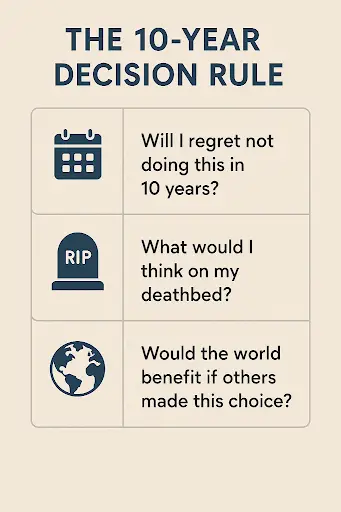
Most founders choke on decisions because they’re zoomed in too close. Every move feels existential when you’re stuck in a quarterly lens. Pull back and the noise drops.
Jeff Bezos calls it the Regret Minimization Framework: “Will I regret not doing this 10 years from now?” It works because it reframes the game. Doing nothing is still a decision, and it’s the one people regret most.
I’ve sat with founders who burned six months debating a pivot. When we ran the 10-year test, the answer was obvious. Even if it failed, they’d regret not trying more than they’d regret a stumble. That shift turned paralysis into action.
This isn’t philosophy. It’s operational. A long lens changes how you execute. Instead of patching short-term holes, you build systems that last. Instead of chasing every “strategic” win, you protect culture and energy because you know those are the assets that compound.
When in doubt, zoom out. The view from 10 years strips away fear and leaves you with what actually matters.
Step 3 – Accept the Trade-Offs (and Write Them Down)
Founders want growth without stress, control without constraint, freedom without risk. That fantasy kills more businesses than bad strategy. Every decision has a cost. Pretending otherwise makes you sloppy.
Write the trade-offs down. Out loud, no hedging. Example: “By saying yes to scaling, I’m saying no to deep creative work and family dinners. I’m hoping for more freedom later, but I accept more stress now.”
Why bother? Because the trade-offs are happening whether you admit them or not. Ignoring them leads to resentment and self-sabotage. Owning them gives you peace. You chose the cost, so you can live with it.
One founder I worked with thought she wanted revenue growth. The exercise exposed something else: she craved space to create and start a family. Her strategy flipped once she named the trade-off. That clarity didn’t just change her business, it gave her life back.
Trade-offs aren’t a penalty. They’re a filter. When you accept the cost upfront, you stop bargaining with reality and start executing with conviction.
Step 4 — Run the Bio-Psycho-Social Check
Most “hard” decisions don’t break on logic. They break because the body, the mind, or the support system can’t carry the weight. Founders try to spreadsheet their way through choices that are biological, psychological, and social at the core. That mismatch is why rational plans collapse.
I use the Bio-Psycho-Social Check with every client. It comes from medicine and therapy, but it works in boardrooms because it exposes blind spots. Think of it as a stress test: if any corner of the triangle is weak, the decision will collapse under load.
- Biology. Does this choice wreck your sleep, health, or baseline energy? Burnout doesn’t make you a hero, it makes you a liability. A fried nervous system won’t close the round or ship the product.
- Psychology. Does the path amplify anxiety and impostor syndrome, or does it strengthen confidence? You can’t scale anything, company, impact, or self, if you’re emotionally shot.
- Social. Does the decision disconnect you from family, friends, or community? Isolation isn’t focus. It’s erosion. Every founder I’ve seen implode had one thing in common: they cut themselves off from support.
I watched a founder push through an aggressive expansion plan while ignoring this check. Six months later, the strategy wasn’t dead, the founder was. Insomnia, panic attacks, and divorce papers. The business didn’t kill him. The triangle did.
Ask yourself the only question that matters: Can I execute at a high level and still enjoy my life while doing it? If the answer is no, the decision is flawed. The Bio-Psycho-Social Check doesn’t just help you pick the right path, it keeps you alive long enough to walk it.
Step 5 – Use Negative Visualization to Defuse Fear
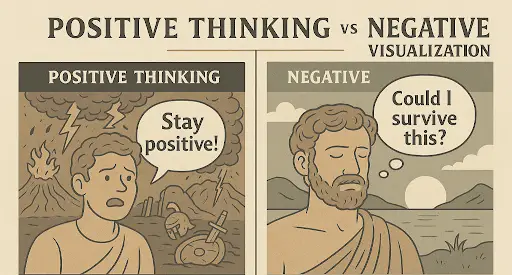
Founders get told to “stay positive” and “focus on the upside.” That advice sounds nice but it’s garbage. Blind optimism keeps you stuck because you never stare down the thing that’s actually running the show: fear.
The Stoics had it right 2,000 years ago. Marcus Aurelius wrote about imagining loss so the fear lost its bite. Modern neuroscience backs him up. Daniel Kahneman’s research shows that when you picture failure in vivid detail, the brain rewires the threat response. The monster shrinks.
I’ve watched it play out with clients. A founder about to raise their first round was paralyzed. Once we walked through the worst case, investors ghost, reputation takes a hit, runway shrinks, the fear collapsed. It wasn’t death. It was a six-month detour and some ego bruises. Suddenly the decision looked survivable. He moved forward.
Try this exercise: write down the absolute worst-case scenario. Spell it out. What if it all goes wrong? Could I survive it? Would I regret not trying, knowing the damage was temporary?
Most of the time, you’ll realize the “worst” is lost time, some money, or a few sleepless nights. You’ll recover. What you gain instead is momentum.
Fear doesn’t vanish by ignoring it. It vanishes when you drag it into the light and strip away its mystery. Negative visualization won’t guarantee success, but it guarantees resilience. And resilience is what keeps you in the game long enough to win.
Step 6 – End the Paralysis: Choose, Act, Adjust
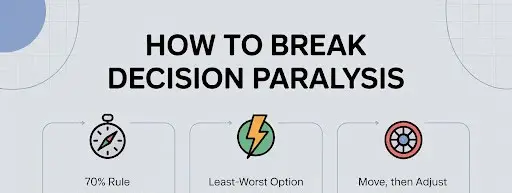
You’ve done the work. You analyzed the risks, zoomed out with the 10-Year Rule, and stared fear in the face. And yet you’re frozen. That’s decision paralysis. Every founder hits it.
Paralysis comes from chasing the perfect choice. Perfection doesn’t exist. The search burns time while the world moves without you. Competitors launch. Markets shift. Windows close.
That’s where the 70% Rule saves founders. Colin Powell put it bluntly: if you’ve got more than 40% of the information and less than 70%, you have enough to move. Certainty past 70% rarely comes before the opportunity is gone.
History proves this. Military leaders, startup founders, investors, they never had perfect data. They acted with conviction, solid preparation, and a plan to adjust on the fly. That combination beats over-analysis every time.
Every day you wait, someone else makes the choice for you. You don’t just risk a bad decision; you risk no decision. And no decision is often the most expensive outcome.
Still overwhelmed? Run the Least-Worst Option test. Pick the path with the fewest downsides and the most momentum. Don’t stall waiting for clarity. Progress compounds. Perfection kills it.
You Don’t Need Perfect Decisions.
Ultimately, founder decision making is about accepting trade-offs and choosing a path that aligns with who you are today.
Your values and goals will evolve. But clarity emerges when you act in alignment with what matters now, not what society, your past self, or some guru told you should matter.
Here’s the roadmap:
- Zoom out with the 10-Year Rule.
- Name the trade-offs in writing.
- Run the Bio-Psycho-Social check.
- Visualize the worst-case and shrink the fear.
- Apply the 70% Rule and act.
You won’t control every outcome. You will control whether you’re proud of the choices you made with the data you had. That’s the measure that matters.
You don’t build a meaningful company by staying stuck at the crossroads. You build it by choosing, moving, and choosing again.
Ready to Make Bold, Aligned Decisions Without Burning Out?
I’ve coached hundreds of founders, operators, and leaders to stop spinning their wheels and start making moves they trust. If you’re staring at a high-stakes decision or sitting in that fog of analysis paralysis, let’s cut through it together!
Sign up to our newsletter today!
We'll map out your options, break down the mental roadblocks, and build a clear, personalized decision-making framework that supports both your ambition and your well-being.
You need a better compass, not another productivity hack. Let’s build it together.
See more posts like this
Join The Sauce.
Weekly tactics to grow, lead, and build your startup without the fluff.
Join 2,500+ other founders