
Product Market Fit Validation: Stop Building Products Nobody Wants

Farzad Khosravi
The No BS Startup Coach

Now you’re six weeks into building a product nobody opens. Signups stall. Feedback turns vague. The enthusiasm’s gone. What happened?
Early signs of traction can be misleading. Surface-level interest often masks the harder truth: people like ideas more than they commit to them. Building off that kind of signal leads to stalled launches, disengaged users, and weeks of work tied to assumptions.
That’s why product market fit validation needs more than positive feedback. It needs evidence. Not vague enthusiasm. Not polite affirmations. Actual proof that someone has a problem, and is willing to act on it.
Real Signals: What Actually Validates Product Market Fit
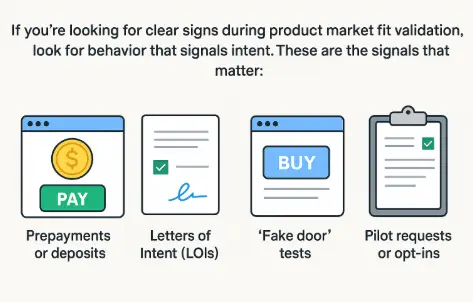
You don’t need more people saying they like the idea. You need people showing up with something to lose. Real validation happens when someone is willing to trade money, time, or access in exchange for what you’re building. That’s when interest turns into commitment, and commitment is what moves a product forward.If you’re looking for clear signs during product market fit validation, look for behavior that signals intent. Not passive engagement. Not theoretical interest. Action.
These are the signals that matter:
- Prepayments or deposits: Nothing filters for urgency faster than asking someone to pay. Even a small fee changes the dynamic. It tells you they believe the problem is worth solving, now.
- Letters of Intent (LOIs): If you’re working B2B, an LOI is a clear step forward. It may not be binding, but it’s formal enough to show internal alignment on their side.
- “Fake door” tests: Create a landing page with a clear offer. Include a buy button, a signup field, or a calendar link. Then track who clicks. This kind of startup MVP testing reveals what people intend to do, not just what they say they’d do.
- Pilot requests or opt-ins that require effort: If someone fills out a detailed form, commits to a use case, or provides internal data, that’s worth far more than a one-click subscription.
Product market fit validation isn’t about making people say yes. It’s about giving them the chance to walk away, and seeing who stays.
Transitioning from Conversations to Commitments
The bridge between interviews and commitment is friction. The moment you add it, whether through pricing, timelines, or effort, intent becomes visible. That’s when you start separating polite interest from real demand.
Here’s how to move beyond early discovery calls and into high-signal validation:
- Reframe your interview questions: Stop asking, “Would you use this?” Start asking, “When was the last time you tried to solve this?” or “What have you paid for to fix this in the past?”
- Add a next step at the end of every call: If the problem feels urgent, ask for a deposit or suggest a pilot. If they hesitate, ask what’s missing.
- Use landing pages as filters: Build pages that reflect your offer, pricing, and timeline. Drive traffic through targeted outreach or ads. Then track conversion, drop-off, and scroll depth.
- Layer in a basic offer: Before you write a line of code, offer the outcome manually, consulting, workshops, spreadsheets, or mockups. If no one buys the manual version, the automated one won’t fix that.
This is where startup MVP testing becomes useful. It gives you room to test pricing, positioning, and product mechanics before building a full version. If someone won’t pay for a stripped-down version, a polished UI won’t convince them.
Your goal during product market fit validation isn’t to convince people the product is good, it’s to find people already trying to solve the problem and willing to do something about it. The earlier you can force that decision, the clearer your path becomes.
When to Build an MVP (and When Not To)
Early-stage founders often treat the MVP like a starting point, but in most cases, it's a detour. If you’re building before you’ve seen commitment, you’re guessing. That guess becomes a product roadmap, which becomes a backlog, which becomes technical debt tied to a problem no one’s paying to solve.
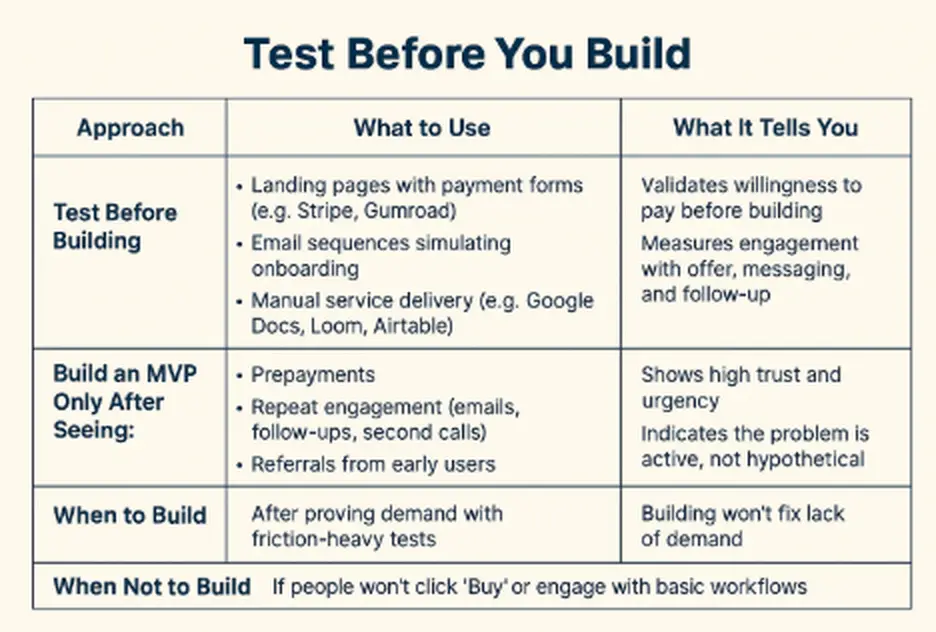
The purpose of an MVP is not to validate demand. The purpose is to deliver a version of something people have already shown they want.
Until then, use startup MVP testing tools that don’t require engineering. You can learn what you need without writing a single line of code. That’s not a shortcut, it’s the work.
Here’s what that looks like:
- Landing pages with payment forms (Stripe, Gumroad, Lemon Squeezy): If they won’t click "Buy," you don’t need to build the product.
- Email sequences that simulate onboarding: Test the messaging, the offer, and the follow-up. If people don’t engage now, they won’t engage later.
- Manual fulfillment: Build your service as a workflow before you invest in automating it. Not scalable? Perfect. You’re validating, not scaling.
Only after you’ve seen strong signals, prepayments, repeat engagement, referrals, should you consider a scoped-down version of the product. That version is built to serve existing behavior, not to create it from scratch.
During product market fit validation, the MVP doesn’t come first. Proof comes first. The MVP exists to support something that’s already working in a rough, manual form. If there’s no traction without the product, the product won’t save you.
The Anti-Vanity Checklist
It’s easy to mistake activity for traction. Waitlist signups, retweets, and kind words feel like movement, but they rarely convert into customers. That’s why you need a filter, a way to separate noise from actual signals.
Use this list to check your current validation strategy. If you’re not seeing at least one of these responses, you're not done testing.
You’re getting close to product market fit validation when:
- Someone prepays, even if it's a small amount
- A company offers to sign a Letter of Intent
- Prospects ask, “When can I get access?”
- They refer someone else without being prompted
- They follow up with questions, use cases, or budget
- They’re willing to test something manual or unfinished
Now compare that to this list. These are vanity signals. They feel good, but they don’t count.
These are not validation:
- “That’s such a cool idea.”
- “Let me know when you launch.”
- Unsolicited praise from people who don’t match your ICP
- 100+ waitlist signups with zero conversions
- Likes and retweets
There’s no need to waste months building for an audience that never committed in the first place. Your time, money, and energy are finite. Use them on people who are willing to move.
The Cost of Ignoring This
When you skip product market fit validation, you don’t get to skip the consequences. You delay them. Low engagement, slow sales, constant pivots, those are all symptoms of a product that was never validated in the first place.
And if you’re somewhere in the middle, some interest, some feedback, but no hard proof, this is where a structured approach can shift everything. My customer validation framework helps early-stage founders move from conversations to clarity, from ideas to traction. If that’s where you are, let’s fix it now instead of six months from now.
If you’re figuring out how to run those tests, or what to build next based on real demand, I share step-by-step frameworks at, built from coaching 500+ founders through this exact stage.
Product market fit validation isn’t a checkbox. It’s how you stop building in the dark.
See more posts like this
Join The Sauce.
Weekly tactics to grow, lead, and build your startup without the fluff.
Join 2,500+ other founders