
The Three Great Success Myths
Last updated

The No BS Startup Coach
The older I get, the less I believe in simple explanations.
Every founder, executive, and operator I coach wants clarity, about people, direction, and purpose. They want a fix. But clarity doesn’t come from sharper strategy or a louder voice. It comes from stripping away the lies we tell ourselves to survive.
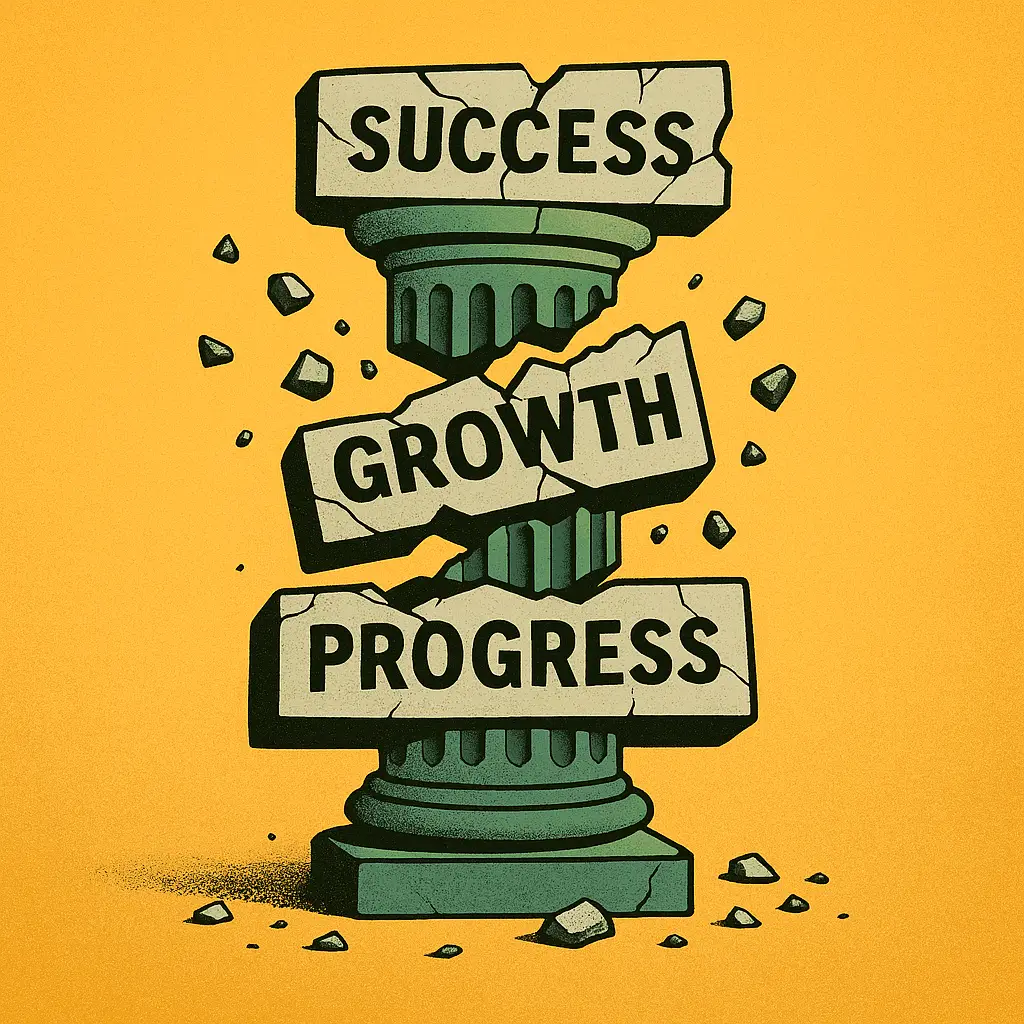
These lies sound practical. They sound like leadership. But they’re traps, seductive half-truths that make good people double down on bad logic. I call them The Three Great Success Myths.
Let’s start with the first one.
Myth #1: You Can Fix Complex Problems with Simple Actions
In 2023, I introduced a former Fortune 100 executive, let’s call him Todd, to a potential buyer for his new software. The meeting went well. The buyer was interested. Todd was confident.
Two weeks later, I called to check in. “What deal?” he said.
He had completely forgotten about the follow-up. His salesperson had sent three reminders, but Todd never replied. When I asked how he planned to move things forward, his first instinct was to fire that same salesperson for “not closing.”
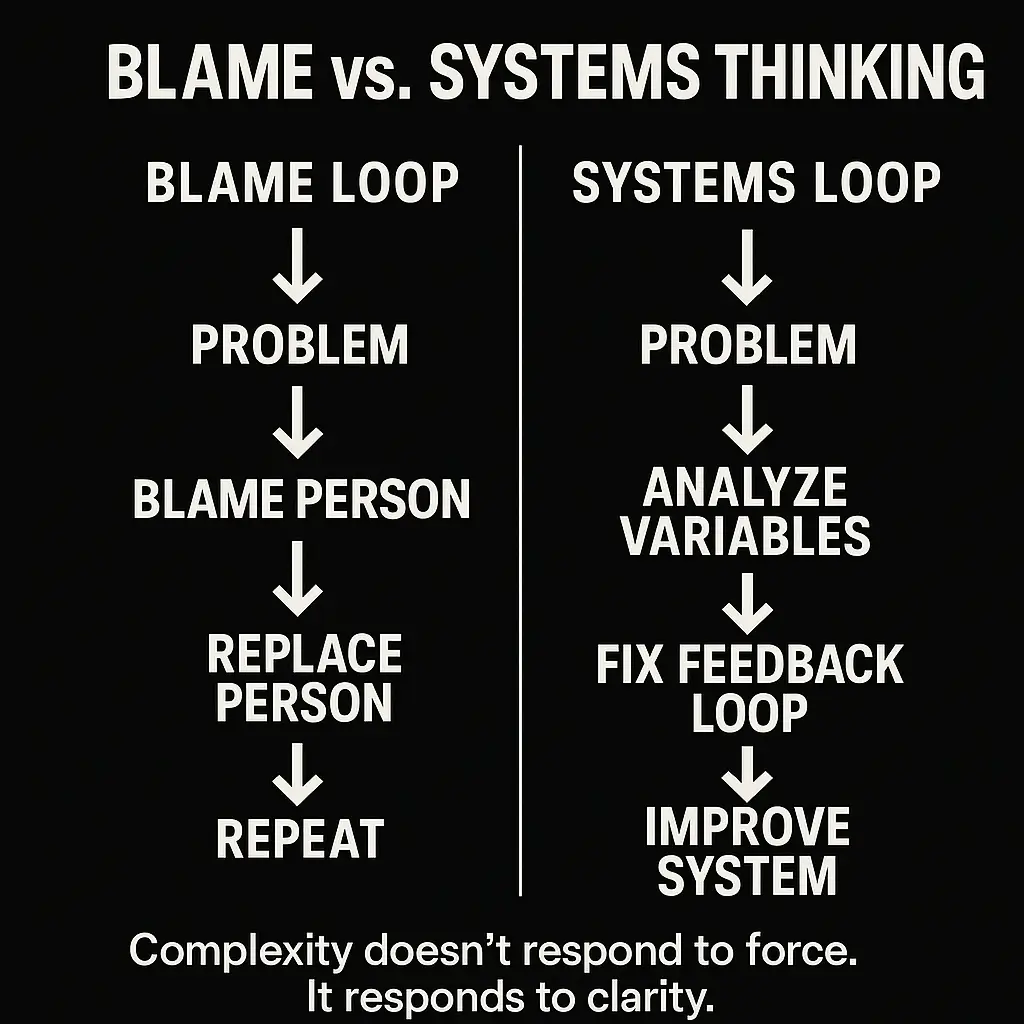
It’s a perfect example of how the brain protects our ego by simplifying blame. Psychologists call this the fundamental attribution error, the bias that makes us point to people instead of systems. Todd didn’t need a new salesperson. He needed a new way to see the problem.
When I told him, “You’re not lazy. You’re overloaded. Your brain’s trying to turn a complex issue into a simple one because it’s tired,” he paused. Then he nodded. Because he knew it was true.
Almost nothing in business is a single person’s fault.
Still, we act like it is.
I saw the same reflex in a Series A CEO I coached last year. He’d built his company during the 2021 mania, capital was cheap, demand was irrational, and even average execution looked brilliant. Then 2022 hit. Growth slowed. Investors stopped saying yes.
He called me and said, “My Director of Sales has lost his fire. I think I need to replace him.”
When we looked closer, it was obvious what had changed. Product development had stalled. The market had shifted. Net revenue retention was down. The Director wasn’t the problem. The system was.
“Fire him,” I said, “and you’ll get six weeks of relief before you invent a new scapegoat.”
He laughed. Because deep down, he already knew.
Why We Do This
The Ape Brain can’t tolerate uncertainty. It evolved to find predators fast, not to map complex interdependencies. So when a business stalls, our primitive wiring scans for a single face to blame. It’s survival.
That’s why leaders overreact. It’s why blanket policies exist. It’s why meetings spiral into punishment rituals instead of analysis.
A 2022 study in the Journal of Business Ethics backs this up. When managers replaced blame with systemic investigation, asking what changed upstream, sales performance and team trust increased by more than 30%.
Complexity doesn’t respond to force. It yields to clarity.
If you want to stop playing corporate whack-a-mole, ask these three questions before you make a decision:
- What variables changed right before this broke?
- Which feedback loop failed silently?
- What behavior am I reinforcing by my reaction?
Leaders don’t lose companies through incompetence. They lose them through pattern blindness.
Myth #2: Telling People How to Improve Makes Them Better
Every manager thinks they’re being helpful when they say, “Can I give you some feedback?”
But most feedback is about control.
One founder I coached prided herself on “radical honesty.” Every Friday, she held “real talk sessions” where she listed each person’s mistakes in front of the team. She called it transparency. Her team called it Friday punishment.
I sat in on one session. It was silent except for her voice. People took notes like hostages writing ransom letters. When it ended, she turned to me and said, “Did you see how engaged they were?”
I said, “They weren’t engaged. They were scared.”
The Science of Fear
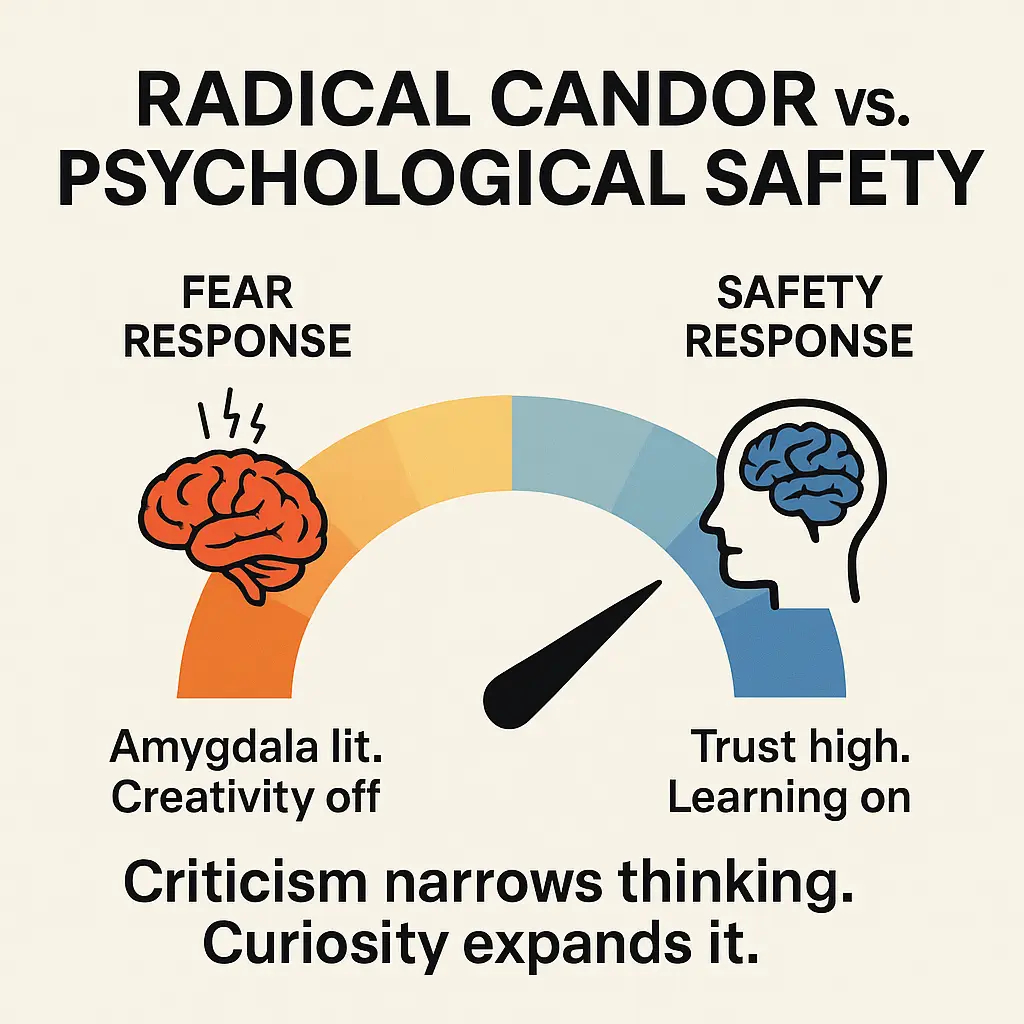
The human brain interprets unsolicited criticism as a threat. The amygdala lights up, cortisol spikes, and higher reasoning shuts down. You don’t get performance. You get paralysis.
Harvard’s Amy Edmondson proved this years ago: teams with psychological safety, not radical candor, outperform others by wide margins.
The Wrike 2023 Stress Report found the same pattern. Eighty-three percent of employees who receive frequent “correctional feedback” report higher stress and lower creativity. In our attempt to ‘improve’ performance with critiques, we cause anxiety instead. People don’t innovate when they’re anxious. They minimize risk. They shrink.
How to Reverse It
I worked with another founder who ran 1:1s like cross-examinations. “Why didn’t you hit this number?” “What went wrong?”
I told him to stop interrogating and start inquiring. Replace questions of blame with questions of energy:
- “What part of this week energized you most?”
- “Where did you feel stuck?”
- “What would make next week easier?”
After a month, he noticed something strange. His team started fixing issues before he saw them. He didn’t need to micromanage anymore.
Criticism narrows thinking. Curiosity expands it.
You can’t shame people into excellence. You can only make it safe enough for them to see the truth.
Why This Matters
In a world addicted to speed, empathy feels slow. But it’s the only thing that compounds.
When people feel safe, they think critically. When they think critically, they improve systems. When systems improve, outcomes follow. That’s managerial leverage, getting exponential output through trust instead of pressure.
Leadership is about creating the psychological space where people can find their own.
Myth #3: Experience Equals Wisdom
Every company worships experience until they pay for it.
I’ve seen founders chase the “experienced hire” like it’s a cheat code. They picture someone who will walk in and fix everything. But experience is a fossil record, it tells you where someone’s been, not whether they can adapt.
A client once hired a VP from a major tech company. On paper, flawless. He’d led teams of 200, scaled revenue into the tens of millions, and could recite leadership frameworks in his sleep. Six months later, morale had cratered.
When I asked what happened, the CEO said, “He keeps rebuilding what worked at his last company.”
That’s the trap. Success is contextual. What worked in a hyper-funded growth environment fails in a lean one. What worked in 2019 doesn’t work in 2025. Yet we keep mistaking familiarity for competence.
The Evidence Gap
Research confirms this bias.
Vox reported in 2022 that experienced hires underperform in new environments 60% of the time because they “overfit” to prior systems. They rely on pattern recognition instead of fresh observation.
Invensis Learning found that most recruitment failures come from overvaluing “track record” and undervaluing adaptability. The lesson is simple: the market doesn’t reward your résumé; it rewards your learning rate.
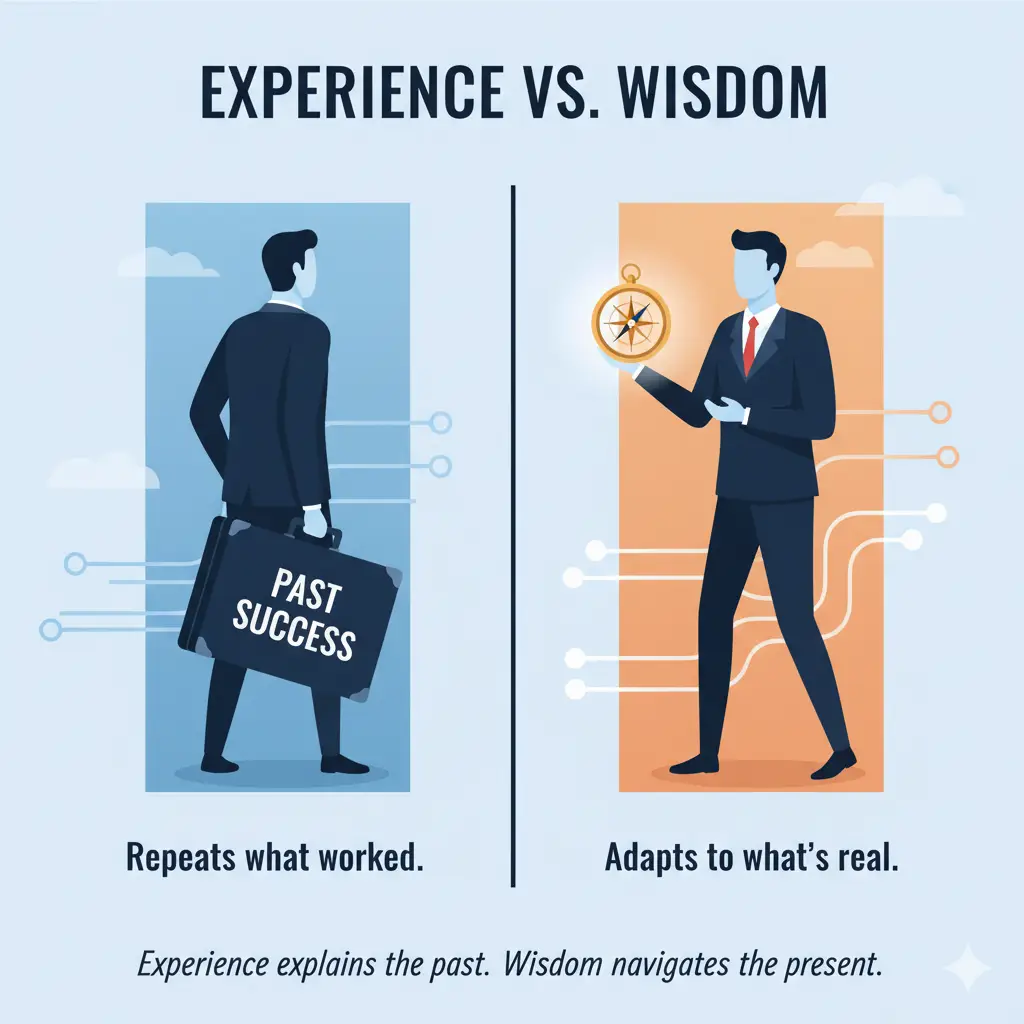
Experience explains the past. Wisdom navigates the present.
When I ask leaders what they mean by “experience,” they usually describe exposure, time in the seat, hours logged. But wisdom isn’t about time. It’s about discernment: the ability to separate signal from noise and adjust when reality shifts.
Experience helps you repeat what worked. Wisdom helps you abandon it when it stops working.
Why We Keep Falling For It
The Ape Brain confuses age with depth. It craves certainty, and experience looks like certainty on paper. A decade of credentials feels safer than a mind that still questions everything.
But safety doesn’t build resilient systems. Curiosity does.
Hiring the “experienced savior” is a short-term comfort strategy, a way to outsource anxiety about the unknown. That’s why so many organizations swing between inexperience and burnout: they hire for the past, not for the pace of change.
Slate ran an analysis in 2022 on post-pandemic hiring trends and found something telling. Employers claimed to want innovation but filtered out candidates who hadn’t “proven themselves” in the old world. The result? Teams optimized for conformity instead of discovery.
If you want wisdom, stop hiring for prestige. Hire for pattern awareness, self-correction, and humility.
How to Spot Wisdom Instead of Experience
- Look for pattern language, not bullet points.
When someone describes their wins, ask how they made decisions. The wise talk about uncertainty. The experienced talk about results.
- Probe for context-switching.
Ask, “What worked there that wouldn’t work here?” If they can’t answer, they’re a liability.
- Test their learning loop.
Ask what they’ve changed their mind about in the last year. If they can’t name anything, they’re not evolving.
Hiring for wisdom is slower. But it compounds. It’s how you build long-termist cultures that adapt faster than the market.
The Thread That Connects the Myths
When you strip these myths down, they share the same root: control.
- The first myth says, “I can fix this by changing one person.
- The second says, “I can fix others by telling them what’s wrong.”
- The third says, “I can buy certainty by hiring experience.”
All three are symptoms of the same fear, the fear of not being in control.
That fear is the Ape Brain at work again. It hates ambiguity, so it turns complexity into a story where you’re the hero. But leadership is a mirror.
The systems you build reflect how you think. If your thinking is reductionist, your company will always oscillate between blame, burnout, and bureaucracy.
The Science of Self-Deception
Behavioral economists like Daniel Kahneman have spent decades proving that humans aren’t rational decision-makers, we’re storytellers. We invent cause and effect so our world feels stable. Kahneman called it “the illusion of understanding.”
That illusion runs most companies.
We convince ourselves we know why something worked. We make decisions based on those narratives. Then we confuse luck for strategy.
The only way out is metacognition, the habit of thinking about your thinking. You can’t fix what you won’t notice.
The philosopher Epictetus wrote, “You cannot learn what you think you already know.” That’s the essence of leadership. If you can’t question your own narrative, your narrative will destroy you.
The Alternative: Truth as Operating System
The opposite of control is clarity.
Clarity begins with humility. Most problems worth solving have more than one cause. Founders who run blameless post-mortems learn faster than those who run witch hunts. Teams that value psychological safety outperform those that glorify “radical candor.” Wise leaders hire for adaptability, not nostalgia.
Truth is an advantage.
Leaders who trade blame for systems thinking, feedback for curiosity, and ego for inquiry create cultures that grow stronger under stress. These teams don’t crumble when things go wrong. They learn faster, recover faster, and make better decisions the next time.
Action Framework: The No-Blame Audit
Run this exercise with your leadership team every quarter.
- Identify one failure from the past 90 days.
- List every contributing factor, people, process, timing, market.
- Label which factors were within your control.
- Ask what signals could have revealed the issue earlier.
- Write one concrete change that lowers the chance of recurrence by 10%.
That is how pain becomes data and data becomes resilience.
Ethics and Longevity
Doing the right thing is leverage.
Ethical leadership keeps a company alive. A 2022 Journal of Business Ethics study showed that teams led by consistent, honest managers sold more, performed better, and stayed longer. Those managers kept promises, admitted errors, and protected their people.
Ethics grow like interest. Each honest act adds stability. Each shortcut removes it.
Short-term control burns people out. Long-term clarity builds capacity.
Leaders who stay honest win because their teams keep showing up when it matters.
The Close: The Leader in the Mirror
You can’t lead people you don’t understand, and you can’t understand people if you don’t understand yourself.
Every founder wants frameworks. The hard truth is that frameworks don’t save you from reflection, they make reflection visible.
So before you fire someone, or deliver “honest feedback,” or hire a trophy executive, ask yourself one question:
What story am I telling myself right now to feel safe?
That story might be your company’s biggest risk.
Leadership is about calibration, knowing when to act, when to pause, and when to admit you don’t know.
If you can do that, you don’t need more hustle or more experience. You already have what most leaders spend their whole careers chasing: clarity.
Do the right thing because it’s right. Profit will chase you.
Stop managing people through illusion. Start managing systems through truth.
That’s where leadership begins.
Related Startup Guides
All articlesGrow
The lie founders tell before they waste 3 more months
Stop thrashing between marketing channels. Learn why your diagnosis is likely the problem and how to fix your foundation for real growth.
Grow
How Emotional Resilience Impacts Business Decisions
How Emotional Resilience and Communication Shape Better Business Decisions...
Grow
How to Make Hard Business Decisions You Won’t Second-Guess
How to Make Hard Business Decisions You Won’t Second-Guess...
Farzad Khosravi
No BS Startup Coach · 500+ Founders Coached
I help early-stage founders launch, grow, and lead with clarity — cutting through the noise to tactics that actually move the needle. I've coached 500+ founders across validation, growth, leadership, and fundraising.
Join The Sauce.
Weekly tactics to grow, lead, and build your startup without the fluff.
Join 2,500+ other founders