
How to Find People to Interview for Customer Discovery

3x founder · Coach to 500+ founders
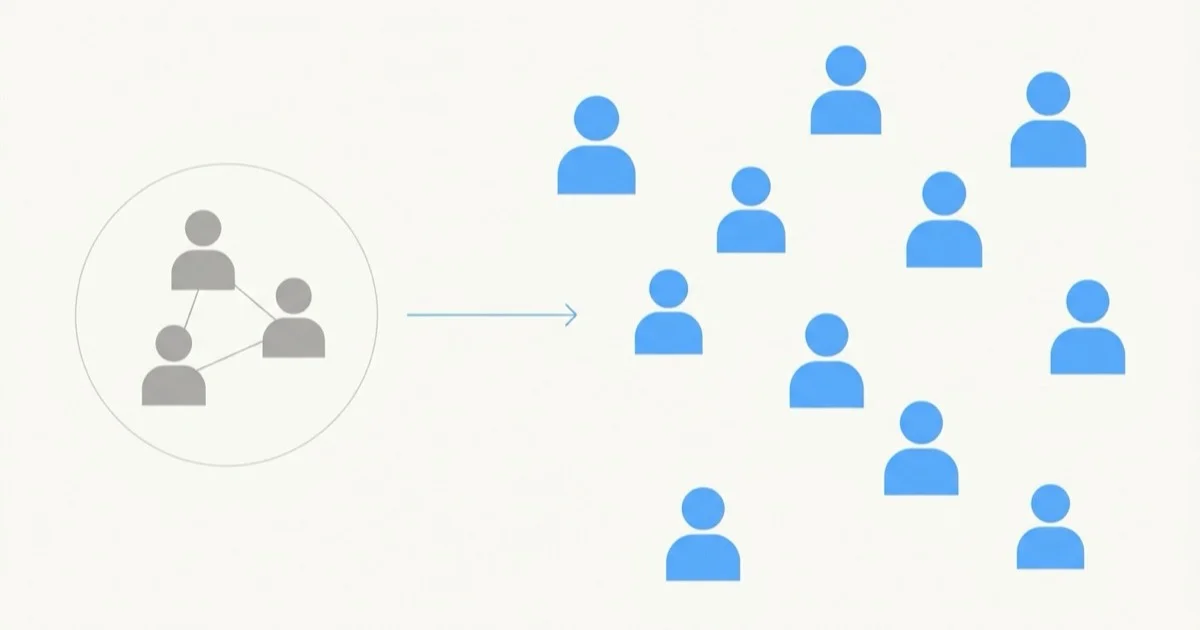
A founder I coached had five people lined up for customer interviews. All five came from her own network. Three weeks in, the list had stopped growing, and she was ready to call the idea validated.
Five friends of friends is not a sample. It’s a mirror.
Here’s the short version. You find people to interview for customer discovery in four places: niche communities where your buyer already complains, LinkedIn title search, conference speaker lists, and named reviewers on competitor tools. Pull from at least three of them. Cap any single source at 30% of your interviews, and cap your own network at 30% too. The channel list is the easy half. The sampling rule is what decides whether ten conversations tell you the truth or hand you back your own assumptions in someone else’s voice.
Why most founders can’t find people to interview
Almost every guide on this opens the channel list the same way: ask your network, get warm intros, work outward. The advice itself is fine. Jason Cohen’s rundown of 19 ways to find people to interview is the most thorough one on the internet, and his first ground rule is blunt about the limit: only interview your ICP, because friends and family will tell you it sounds cool and can’t tell you whether real buyers will pay. His network move is about getting introductions to buyers.
Founders skip the second half of that sentence. They read “ask your network,” book three warm calls in an afternoon, and stop. The bridge to actual strangers never gets crossed.
That’s how you end up at five interviews, all from two degrees of separation, feeling validated. Your network shares your assumptions. That’s usually why those people are in your network. They work adjacent roles, they read the same things, and they’ll find your idea reasonable before you finish describing it.
There’s a second problem underneath. Warm contacts answer because they want to be helpful. Strangers answer because the problem is real to them. Only one of those two signals survives contact with a pricing page.
So make it a sequencing rule. Ten strangers before you talk to anyone you know.
Where to find people to interview for customer discovery
Four channels. Each has a different failure mode, which is exactly why you use more than one.
1. Niche communities where your buyer already complains
Reddit subs, Discord servers, Slack groups like RevGenius or Indie Hackers, specialty forums, “Ask HN” threads. Your customers are already describing their problem in public, in their own words, for free.
Don’t post your idea. Use the ask-for-advice move instead: “Has anyone else struggled with [problem]? How did you fix it?” People love giving advice. Nobody bans you for asking a real question. Then the thread itself becomes your recruiting list, because everyone who replied just self-identified.
The protocol that makes this work is countable. Find three places where 100+ of your buyers actually post. Lurk for two weeks. Comment helpfully five times a week. Bank twenty useful comments before you mention what you’re building. Founders who run this pattern get five to fifteen replies per post, repeated across three to five communities.
For finding the rooms themselves, Disboard searches Discord servers and F5Bot sends free keyword alerts for Reddit and Hacker News. I’ve written up the subreddit side of this in detail, including the tooling and the karma rules that keep you from getting removed.
Failure mode: communities skew toward the loud and the chronically online. Great for finding pain, bad as your only source.
2. LinkedIn title search
Search by job title plus an industry term. Send ten to twenty personalized messages a day.
The message that works asks one specific question and offers something back. Fifteen minutes, you send them your notes afterward, and you say the words “no pitch” out loud. People answer questions. They don’t show up for vague calls with a stranger who wants to “pick their brain.”
Write one real personalization line per contact. A recent post, a company announcement, something they actually said. “I see you work at Acme” fools nobody.
Failure mode: you’ll over-index on people active on LinkedIn, which correlates with job-seeking more than with your problem.
3. Conference speaker lists
This is the channel almost nobody writes about, and it’s the best free list you can get.
Every conference in your space publishes its speaker roster months ahead. Those people stood up in public and said they care enough about this problem to talk about it for forty minutes. They’re named, their employer is listed, and their topic tells you their exact angle. They’re also easier to reach than a cold title match, because a speaker is used to strangers contacting them about their talk.
Pull the roster from the last three years of the two or three biggest events in your category. Reference the specific talk in your first line. You’re contacting someone about the thing they chose to be public about, which is why this beats generic cold outreach.
Failure mode: speakers skew senior and skew toward people who like being visible. They may not do the daily work.
4. Named reviewers on competitor tools
Go to G2 or Capterra and read the one-star and two-star reviews of the tools your buyer already uses. Then find the person who wrote it.
The distinction matters. Most advice tells you to mine the review text for insight, and that’s a good use of an afternoon. I’ve covered how to run that properly. Here the reviewer is the lead. Somebody who took twenty minutes to write an angry public review has pre-existing rage about your problem space, has already paid for a solution, and has already tried something. That’s three behavioral signals before the call starts. Most reviewers list their role and company, which is enough to find them.
Failure mode: angry reviewers are a biased slice by construction. They churned. You also need people who stayed.
Three sources, 30% each
Here’s the rule that matters more than the channel list.
If all ten of your interviewees come from one Reddit thread, the pattern you find is poisoned. The people who reply to a given thread are systematically different from the average person with the problem. They’re more online, more opinionated, and more likely to be in a specific stage of frustration.
Recruit from at least three sources. Cap any single source at 30% of your sample. Cap your own network at 30% as well, because warm contacts do belong in the mix eventually, once they’re a minority of it.
Track where each person came from. My validation worksheet makes “where you found them” a required field on the interview target list, and it’s there for a reason. When a pattern shows up, the first question to ask is whether it’s real or an artifact of one room.
Screen before you book
Recruiting isn’t finished when someone says yes. It’s finished when someone qualified says yes.
Three questions, all about behavior rather than demographics:
- Do you currently do [the target activity]? How often?
- Did you pay for a tool or service to do this in the last twelve months?
- What’s your role, company size, and decision authority on tools like this?
If they don’t qualify, don’t book. Tell them you’re looking for a slightly different profile right now and you’ll keep them in the loop. Founders skip this step because saying no feels rude, and then they spend an hour with the wrong persona and count it as an interview.
One more filter that’s easy to miss. Recruit people who are in the middle of the problem right now. I coached a founder building certification prep who planned to interview people who’d already earned their certification. Those people give you nostalgia. The people still struggling give you demand.
How many strangers is enough?
Ten is the floor. The spread matters more than the count.
When I worked with Todd Sullivan at Flightfox, we ran twenty interviews in three weeks across three pools: their best customers, their churned customers, and buyers they’d never landed. That spread is what made the pattern readable. Fourteen months later the company went from $9M to $25M in revenue, with one new hire and zero extra marketing spend.
My own version of this lesson cost more. In college we were building a marketplace for farmers. It took until call eighteen for an Iowa farmer to tell me: “Son, I shake hands before I buy. I look a man in the eye. You can’t do that through a damn screen.” Seventeen calls of polite interest, then one call that ended the company. If we’d stopped at five, we’d have built it.
Stop when new interviews stop surprising you. If interview nine tells you what interview four already told you, in nearly the same words, you have a pattern. If every call still sounds new, keep booking.
Where this breaks
Three honest limits.
If your buyers aren’t online, none of the above works. Some audiences genuinely aren’t: trades, agriculture, local services, older demographics. Go to trade associations, local meetups, and industry events, and run the same play in person.
If you already have revenue, your best recruiting pool is your own customer list, split the way Flightfox split it. Current, churned, and never-landed. The stranger rule is for founders with nothing yet.
And sometimes interviews are the wrong tool entirely. If your buyer is impossible to reach at your stage, a few hours reading competitor reviews will teach you more than three badly-recruited calls. Interviews win when you can actually recruit a clean sample. When you can’t, be honest about that instead of running ten bad calls and calling it discovery.
What to do next
Once you have ten strangers booked, the questions you ask decide what you get. The customer discovery interview framework covers the four questions that surface behavior instead of compliments. From there, validate your startup idea picks up the testing sequence, and the startup guide walks the whole five-stage path.
If you’d rather pressure-test the idea before you spend three weeks recruiting, the Startup Idea Validation Scorecard takes three minutes.
Your network will tell you the idea is good. That’s what networks are for. Go find ten people who owe you nothing.
Related Startup Guides
All articlesIdeation
Problem Validation: Are You Solving a Real Problem?
Problem validation is the step most founders skip. How to tell if you are solving a real, painful problem before you spend months building the wrong product.
Ideation
Customer Discovery Interview Questions That Get Receipts
Compliments kill startups. The 4 customer discovery questions that surface real buying signal, where to find 10 strangers, and how to read behavior.
Ideation
How to Validate Your Startup Idea (Before You Waste Months Building It)
Learn a practical 4-step framework to validate your startup idea before spending months building it. Avoid the common traps that lead to early failure.
Farzad Khosravi
No BS Startup Coach · 500+ Founders Coached
I help early-stage founders launch, grow, and lead with clarity. I cut through the noise to the few tactics that actually change your numbers. I've coached 500+ founders across validation, growth, leadership, and fundraising.