
A Content Marketing Strategy That Sells

3x founder · Coach to 500+ founders
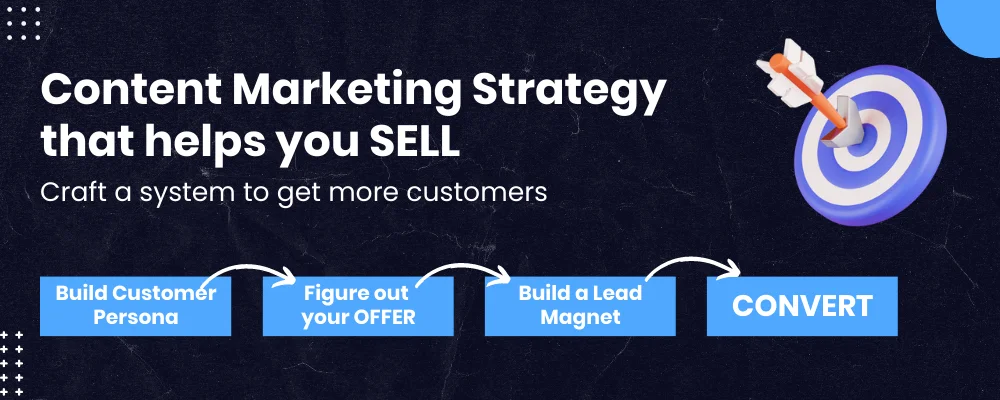
What makes a content marketing strategy sell?
Paid ads never worked for me. I put money in, got clicks, and watched them bounce.
Content did the opposite. My No BS Startup Guide has passed 10,000 downloads, and almost every one traces back to something I posted for free. A reader found a LinkedIn post useful, followed me, grabbed a lead magnet, and some of those readers bought.
A content marketing strategy sells when every piece feeds a path to an offer. One persona. One channel. A lead magnet that captures the email, and an offer at the end. Break any link in that chain and you’re producing free entertainment for an algorithm.
Most founders break the chain in the same place. They post. They stay consistent. They never build the part that sells.
Why most founder content marketing earns nothing
The standard advice says “post consistently and the leads will come.” That’s half a strategy. Consistency without a capture path builds an audience that costs you 10 hours a week and pays you zero.
Here’s the test I run with coaching clients. A stranger loves your post today. What happens next? If the honest answer is “they scroll on,” you have a hobby.
Hold yourself to two floors:
- 100 organic email subscribers a month by month 3. That’s the minimum for a B2B list. Under it, a link in your chain is broken: wrong channel, weak magnet, or content with no point of view.
- A 0.5% reply rate on your emails. Below that, you’re publishing content nobody would miss. Generic gets ignored.
One more filter before you start. Content compounds over months. It’s a growth channel for a validated product. If you’re still testing what to build, cold outreach and fake-door tests teach you more in two weeks than a blog teaches you in six months. Channel pick is downstream of stage, and the Startup Growth Playbook covers when content fits the founder you are versus the other channels that might fit better.
The chain that turns a reader into a buyer
Five links, in order:
- One persona. “Founders” is a crowd. “A technical founder six months in who hasn’t shipped” is a persona. Know the pain, and know where they spend time online.
- One channel. Two conditions: your buyers are on it, and the format favors what you can produce. For me that was LinkedIn. My clients spend time there, and the algorithm rewarded my kind of writing more than Twitter or Instagram ever did.
- Content pillars. Four to six topics your persona cares about, so you never stare at a blank page. Mine: customer acquisition, validation, fundraising, and founder psychology.
- A lead magnet. The bridge from borrowed audience to owned list. The platform owns your followers. You own your email list.
- An offer. A product, a service, a call. Put it in your profile and at the end of your posts. Some readers are ready to buy today. Make that easy.
How do you build the engine?
Three moves, in order of payoff.
1. Pick one channel and go deep
Splitting across three platforms is the most common self-sabotage I see. Each platform has its own format, cadence, and algorithm. Learning three at once means mastering none.
Pick the one where your buyers already spend time and post there for 90 days. If that’s LinkedIn, the LinkedIn guide is the playbook. If your buyers live in communities instead, read how I got to the top of Reddit before you post anything there. Reddit punishes marketers and rewards contributors.
2. Build a lead magnet that does the reader’s work
Kill the 43-page PDF. Static PDF magnets convert around 2.8%. Interactive quizzes convert at 40.1% and interactive forms at 47.3%. That’s the gap between a download nobody opens and a tool a reader finishes.
Chenell Basilio’s numbers make the same point. Her curated Notion library asked for a first name, one extra field of friction, and converted at 1.5% against 0.1% for her old plain form. A 1,400% lift from a magnet good enough to justify the ask.
The rule: the magnet has to show disproportionate work. “The 23 subreddits founders use to find customers, with posting rules tested for 90 days” earns an email. “Free guide: how to grow your startup” earns a scroll.
3. Turn one idea into a week of content
Justin Welsh runs a $2.3M solo business at roughly 90% margin on one pattern: hub and spoke. The newsletter is the hub. Each issue follows a four-beat template: the big problem, how most people solve it, why that fails, and a better way. Then he cuts the issue into 10 to 20 spokes over four to six weeks: short posts, carousels, contrarian takes, all pointing back to the opt-in.
One thinking session becomes a month of distribution. Format matters too. On LinkedIn, document carousels average 6.60% engagement against 0.26% for single-image posts. Same idea, 25x the reach.
What does this look like when it works?
Mark, a client of mine, built an AI hiring tool with a slicker product than his competitors. Five signups in three months. The product wasn’t the problem. Nobody saw it.
He stopped polishing and started publishing: niche content aimed at recruiters on LinkedIn, until an HR newsletter featured him. 100 paying users in under a month. Same product. The content did the selling.
My own startup Cicero ran the pattern in reverse. Cicero was a newsletter before it was a product. The newsletter tested the bet that people wanted better content curation. Once readers showed up, I asked them what to build and built that. Content doubles as the cheapest demand test you can run.
How do you measure whether it’s selling?
Three numbers, checked monthly:
- Organic list growth. New email subscribers per month, excluding paid. The 100-a-month floor from above. Follower counts are rented applause. The list is the asset you keep.
- Subscriber-to-offer movement. How many new subscribers click through to your offer in their first 30 days? If they read everything and click nothing, the magnet attracts an audience your offer doesn’t serve. That’s a persona mismatch, and more volume won’t fix it.
- Brand search and direct traffic. Search has shifted to answer engines. Ahrefs measured AI Overviews cutting clicks on position-one results by about a third in early 2025, widening toward half by late 2025. Raw rankings tell you less every quarter. People typing your name into the search bar tells you the content marketing is working, even when click reports look flat.
When is content marketing the wrong channel?
Four honest cases:
- You haven’t validated the product. Content grows an audience. It won’t tell you if strangers will pay. Do the validation work first.
- You need revenue this quarter. Content pays out on a 6-to-12-month horizon. If runway is short, founder-led outbound closes faster.
- You’re selling a consumer app. Paid ads beat content for app installs at scale. Don’t fight the economics.
- You have nothing to say. If you can’t name one belief your content argues for, no posting schedule saves you. Pick a channel that doesn’t require a point of view.
The full company-building sequence, with content marketing slotted where it belongs, is in the No BS Startup Guide.
Book a free strategy call if you want to pressure-test your channel pick against your stage before you sink 90 days into it.
The algorithm doesn’t owe you customers. Content earns the attention. The chain converts it. Build both or you’ve built neither.
Related startup guides
Content is one of the two inbound channels that feed the founder-led sales playbook. For the outbound counterpart, read the outbound outreach guide. If you’re still sequencing channels, the startup GTM playbook gives you the order.
Related Startup Guides
All articlesGrow
From Idea to Reality: Your Step-by-Step Startup Guide
Turn your idea into a real company. This startup guide covers validation, your business plan, hiring, brand, launch, and growth, one clear step at a time.
Grow
The LinkedIn Guide: How I Hit 10K Weekly Impressions
The exact LinkedIn strategies I used to scale from zero to 10K+ weekly impressions. Content types, posting tactics, and how to sell without killing your reach.
Grow
Outbound Outreach for Early-Stage Startups: Templates
Outbound outreach for early-stage startups, without scaling spam. Templates, channels, and the operational playbook that gets replies. Steal the system.
Farzad Khosravi
No BS Startup Coach · 500+ Founders Coached
I help early-stage founders launch, grow, and lead with clarity. I cut through the noise to the few tactics that actually change your numbers. I've coached 500+ founders across validation, growth, leadership, and fundraising.