
Outbound Outreach for Early-Stage Startups: Templates

3x founder · Coach to 500+ founders
An agency founder I coach was sending 600 cold emails a week. No qualification and no targeting behind them. Two months in, the pipeline was still empty and he was blaming the channel.
The volume was theater. The missing piece was signal.
Outbound outreach is the fastest acquisition channel an early-stage startup can run. Inbound content takes 6 to 12 months to compound. A clean outbound system can put you in front of your exact buyer inside 2 weeks, on a tool stack that costs less than $200 a month. It’s also the easiest channel to burn. One bad list sent from an unwarmed domain and your emails land in spam for a quarter.
This post is the operational playbook: infrastructure, list, copy, sequence, and the math for reading your results. If you’ve already built the system and replies are flat, that’s a different job. Your cold email isn’t working walks the diagnostic for finding which variable is broken. This is the build guide. That’s the repair manual.
When does outbound outreach make sense?
Outbound works when you can name your buyer. B2B with a $5K+ annual contract value is the primary case. Agencies, consultants, and coaches selling high-ticket retainers fit too. B2C mostly doesn’t, with narrow exceptions. If you built a book summarization app, you can still message people on LinkedIn or X who follow the writers you feature.
The stage gate matters more than the business model. Outbound to an unvalidated persona is the fastest way to torch your sender reputation and spam-flag your domain. If you can’t describe who buys, what pain they’d name out loud, and what they use today, run the 4-step startup idea validation framework first. The Startup Growth Playbook covers where outbound sits in the full channel sequence.
Cleared the gate? Here’s the system, in build order.
Step 1: Build the sending infrastructure before you write a word
Deliverability decides more outcomes than copy does. Most “nobody replies” problems are “nobody received it” problems.
Authenticate your domain. Set up SPF, DKIM, and DMARC on every sending domain. Start DMARC in monitoring mode, then tighten enforcement after 30 days. Sign up for Google Postmaster Tools and watch your spam complaint rate. Keep it under 0.3%. Above 0.5%, Google suspends your sending.
Never send cold from your main domain. Buy 3 to 5 secondary domains (acme.co, tryacme.com) at roughly $10 a year each. Set up 2 to 3 mailboxes per domain and forward replies to your main inbox. Splitting 100 emails a day across 10 mailboxes keeps each one under spam-trigger thresholds.
Warm up new mailboxes. Start at 5 to 10 emails a day, ramp to 20 by week two, and settle at 15 to 25 a day after a month. Smartlead ($39/mo) and Instantly ($37/mo) handle warmup, rotation, and authentication in one place.
Verify every address before sending. A bounced email is a reputation hit. Clean the list with MillionVerifier, NeverBounce, or Bouncer.
The full founder stack runs $155 to $200 a month and sends 100 to 500 verified emails a day without tripping filters. Test placement with Mail-Tester before you scale a single campaign.
Step 2: Build a list that has a reason to reply
Prospecting is where outbound is won or lost. Apollo ($59/user/mo) gives you a 275M-contact database with filters for industry, headcount, tech stack, and hiring signals.
Don’t treat every prospect equally. Tier the list:
- Tier 1 (closest fit, highest revenue): manual research, a fully custom first line, multichannel sequence. 30 to 50 prospects a week, max.
- Tier 2 (mid fit): AI-personalized first line, templated body and CTA. 200 to 500 a week.
- Tier 3 (broad blast): skip it entirely below $50K MRR. You can’t afford to spam an audience you’ll want to re-target later.
Timing beats volume. Send when the buyer just shifted state: a funding round, a new VP hire, a hiring spike that reveals the pain you solve. The sharpest free filter is LinkedIn Sales Navigator set to 40 to 100% headcount growth. Those companies are hiring and have budget right now.
For Tier 1, apply the skip rule. Spend 5 minutes looking for one specific, non-surface-level thing about the prospect: their podcast quote, the company’s origin story, a customer they just landed. Can’t find one? Skip the lead. On a typical 100-prospect list you’ll skip 30 to 40%, and the researched emails that remain hit a 15 to 30% reply ceiling. Templated blasts top out at 3 to 8%.
Step 3: Write the four-sentence email
The structure is Hook, Credibility, Value, Invite. Total length: 50 to 125 words.
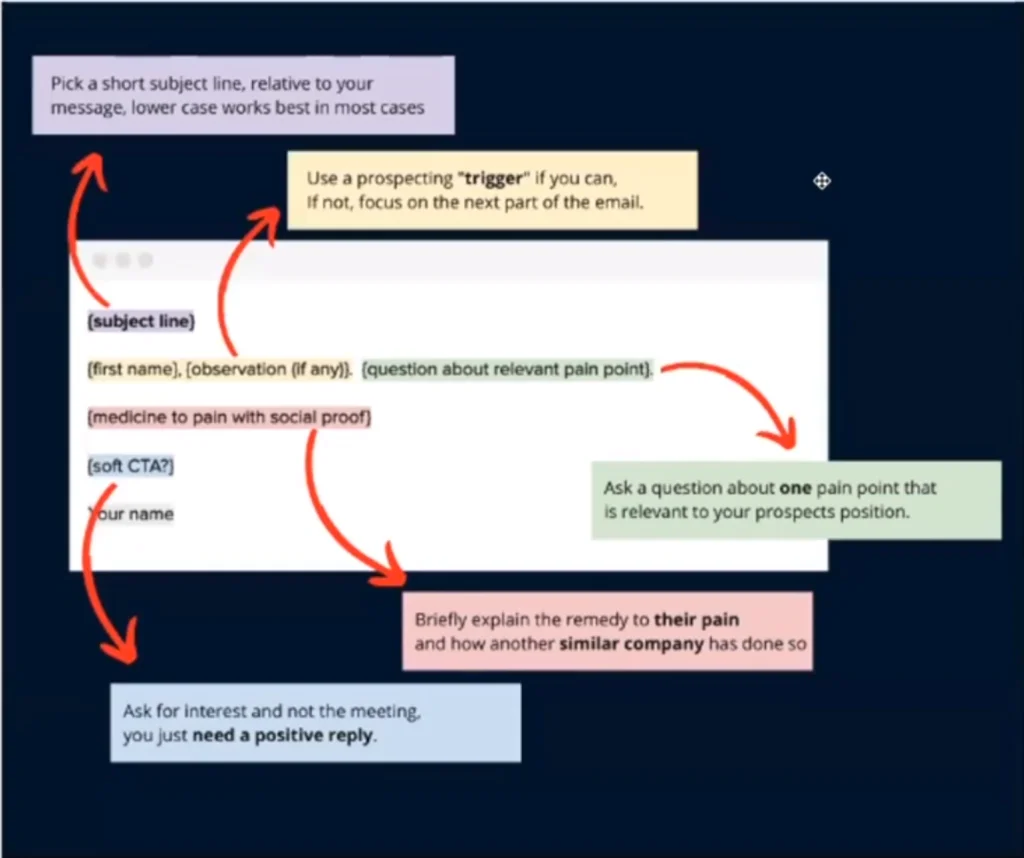
My favorite template compresses it into one question:
Hi Morgan,
If I could help you increase qualified demo bookings by 20% by fixing low reply rates from outbound, would that be of value?
Best, Farzad
One pain, one outcome, one small yes. “Worth a quick chat?” beats “Can I get 30 minutes of your time?” every time, because it asks for interest instead of a calendar slot.
Write the subject line last. Keep it 3 to 6 words, lowercase, and tied to the first sentence of the body. “Acme, dashboard mockup?” reads like an internal email. “Quick question” reads like the other 40 cold emails in their inbox that day.
Step 4: Run the sequence across email, LinkedIn, and phone
One email is a wish. The pattern that books meetings is 6 touchpoints over 30 days.
- Day 1: cold open with the four-sentence framework.
- Day 3: soft bump with a new angle.
- Day 7: a different value or a story.
- Day 14: breakup email that leaves the door open.
Leave the subject line blank on follow-ups so they thread under the first email. The prospect sees one conversation instead of four separate pitches. And make each touch test a different pain hypothesis. “Just circling back” adds nothing and reads like a sequence, because it is one.
Layer LinkedIn around the emails. Comment on their posts before you pitch. Send a connection request. Better: record a 60 to 90 second voice note in the DM. Almost nobody does this, so it cuts through.
For deals above $10K, add the phone. A voicemail left before an email doubles that email’s reply rate, from 2.7% to 5.9%. A third voicemail drops it back to 2.2%, so leave two and stop. On the call itself, skip “did I catch you at a bad time?” It cuts meeting bookings by 40%.
After the breakup email, don’t delete the lead. My rule: if they don’t tell you to f*** off, keep emailing once or twice a quarter. Stay top-of-mind.
What reply rate should you expect?
A median cold outreach campaign in 2026 gets a 1 to 3% reply rate. 5 to 8% is good. Hyper-targeted campaigns under 50 prospects a week can hit 10 to 20%. Below 1%, something upstream is broken: the list, the pain hypothesis, or deliverability.
Run the math before you judge the channel. A 1% reply rate with 10% of replies becoming meetings means 0.1% of contacts become meetings. A thousand contacts buys you one meeting. If you don’t have 500 targeted prospects, you don’t have a test. You have a coin flip.
Track replies and meetings booked. Ignore open rates. Apple Mail Privacy Protection pre-fetches every image and inflates opens by 30 to 50%, so the metric flatters you while the pipeline starves.
When a reply lands, move fast and make it visual. A founder I work with sells an HR tool and was sending PDF decks after cold replies. Deals died in the attachment. He swapped the deck for a 2-minute personalized video naming the buyer’s exact hiring bottleneck and added roughly $70K to pipeline. The video sales letter playbook covers the format.
Where outbound breaks
Five scenarios where this playbook doesn’t pay back, no matter how well you run it:
- Pre-PMF with no clear ICP. You’re spamming guesses. Interview customers first.
- B2C under $50 per user. The math never works. Use ads, SEO, or creators.
- Single-product DTC. Your prospect can click Buy on Amazon faster than they’ll read your pitch.
- Two-sided marketplaces before liquidity. You can’t sell one side without the other side existing.
- Hyperlocal services. Local SEO and Google reviews beat cold email for geo-bound businesses.
If you’re in one of those buckets, outbound is the wrong tool and no template fixes that.
The No BS Startup Guide contains the full outbound chapter this post is built from: cold-calling scripts with word-for-word objection responses, the follow-up templates, and the tool stack tiered by stage.
Book a free strategy call if outbound is on your roadmap this quarter and you want a second set of eyes on your ICP and sequence before you spend on tools.
Outbound rewards the founder who does the boring setup. Send fewer emails to better people, and follow up longer than feels polite.
Related startup guides
Use the startup guide to decide when outbound makes sense in your growth sequence. If you need a warmer acquisition channel, read the content marketing strategy. If your prospects are active on social, pair outbound with the LinkedIn strategy guide. Outbound is one phase of the founder-led sales playbook. The full motion (discovery, demo, close, onboarding) is what you’re building until the conversion rates are stable enough to hand to a real rep. If you’re still figuring out which channel to run before committing to outbound, the startup GTM playbook gives you the sequencing logic.
Related Startup Guides
All articlesGrow
Your Cold Email Isn't Working. Here's Why.
Most founders blame the subject line. It is almost never the problem. A 7-step diagnostic for finding the real reason your cold email is not converting.
Grow
The LinkedIn Guide: How I Hit 10K Weekly Impressions
The exact LinkedIn strategies I used to scale from zero to 10K+ weekly impressions. Content types, posting tactics, and how to sell without killing your reach.
Grow
A Content Marketing Strategy That Sells
A content marketing strategy that sells runs on one persona, one channel, one lead magnet, and one offer. The founder playbook, with real conversion numbers.
Farzad Khosravi
No BS Startup Coach · 500+ Founders Coached
I help early-stage founders launch, grow, and lead with clarity. I cut through the noise to the few tactics that actually change your numbers. I've coached 500+ founders across validation, growth, leadership, and fundraising.